 26.2 Step Mini Marathon
Everyone deserves to cross a finish line.
How one klutzy marathon runner with the BRCA1 mutation turned a family history of cancer into a movement — 26.2 steps at a time.
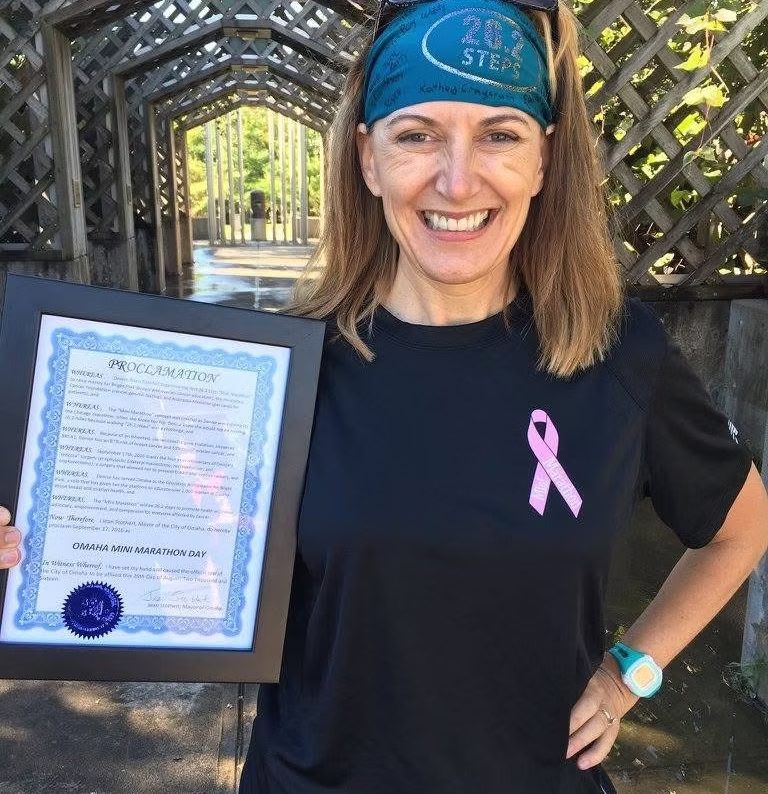
I’m Denise, and I’ll admit it: I’m a klutzy marathon runner who happens to also carry the BRCA1 gene mutation. Those two facts have shaped my life’s trajectory. Because of them, I’ve been able to educate thousands of people on breast and ovarian health and hereditary risk, and I ran the Chicago Marathon four times to raise awareness for this cause. But this crazy little 26.2 “step” mini marathon? I believe it has helped more people than all of that combined. To understand why, I have to start with my mom.
The call
I still remember “the call.” So many people have gotten a version of it, the one where the voice on the other end says, “It’s cancer, but don’t worry, we have great doctors and they say it’s treatable.” I remember being in a fog that day. But just like the doctors promised, over that year she got better, and slowly I let cancer drift to the back of my mind.
About ten years later, I was on a walk with a friend who mentioned that she and her mother were looking into a genetic test for breast cancer. I’d never heard of such a thing. It intrigued me, but I couldn’t see how it applied to me. Little did I know.
When cancer came back
When cancer invaded our lives again, it wasn’t where we expected. My mom had always been vigilant about her breast health, but this time it was in her colon and her spine, and it was aggressive. My conversation about genetic testing was the furthest thing from my mind; every ounce of energy went to helping my mom. This time the doctors were realistic about what we needed to prepare for. We didn’t even get a full year with her before she passed.
With my mom gone, and being a mother to two young children myself, I knew I had to turn my focus to my own health. I finally remembered that conversation on the walk, the one about genetic testing that no doctor had ever raised with my mother or with me. I needed to know: was my mom’s cancer due to bad luck, or bad genes?
“Today is the best your family health history is ever going to be.”
Sitting in that waiting room
Genetic testing was not widely known about at this time, so I started with my mom’s oncologist. Sitting in an oncologist’s waiting room as a healthy person, not a patient, is unnerving, and the irony of being in the very office where my mom had once sat as a patient was not lost on me. I realized how fortunate I was to be getting this information. Most of the people around me were very sick and would have given anything to be in my shoes, to have the chance to learn what caused their cancer and maybe prevent it.
My mom had left home at sixteen, so when I met with the provider for the genetic test I had almost nothing to work with in terms of family health history: just my mom’s own breast and colon cancer history, and a scrap of paper she’d once written on noting that two of her great-aunts had “stomach” cancer. When the results came back, I was positive for the BRCA1 mutation, which put me at significantly high risk for both breast and ovarian cancer, and an elevated risk for other cancers, such as pancreatic.
Becoming a “previvor”
I know how incredibly blessed I am that I found out I carried the mutation before I ever had cancer. That knowledge gave me options. Working with my providers at Nebraska Medicine, I made the decision to have proactive, risk-reducing surgeries. Those choices took my own risk for breast and ovarian cancer from roughly 86% and 64% down to less than 2%, lower than the general population.
My kids were still young, 6 and 8, when I found out my results, and I knew I would do whatever it took not to leave them without their mom. That’s what a “previvor” is: someone who takes preventative steps to lower their risk after learning they carry a hereditary genetic mutation.
The 26.2 steps
In 2016, I was training for my third Chicago Marathon to raise money for a nonprofit focused on high-risk breast and ovarian cancers. Three days after signing up, I promptly walked off a retaining wall and broke my hip. That’s when the idea hit me: still “run” a marathon, but instead of 26.2 miles, change it to 26.2 steps. A friend who had severe mobility issues once told me he could not run a marathon, a 10K, or even jog around the block for someone he loved and lost to cancer, but this he could do, in their honor. That was when I knew this would be bigger than me being a klutz. That was the whole point. Everyone deserves the experience of crossing a finish line, whether or not they could ever train for 26.2 miles. And while my journey started with my mom’s breast cancer diagnosis, I knew I wanted to raise awareness of all the cancers that can be tied to high risk.
What it’s grown into
Ten years later, the 26.2 Step Mini Marathon has helped spread awareness about all high-risk cancers. It has helped people learn to ask the right questions and build an action plan that’s right for them. Along the way, I’ve served as a board member of the Hereditary Cancer Foundation, an Education Ambassador for Bright Pink, and a Patient Advocate Leader for the national nonprofit FORCE (Facing Hereditary Cancer Empowered). I’ve even testified before our state legislature in support of protecting people from genetic discrimination by insurers, because I have met people who are more afraid of being denied coverage than of getting tested, and that is just wrong.
Where we’re going
When I speak to people about risk, I tell them the same thing: today is the best your family health history is ever going to be. A lot of us assume our doctor will just bring up genetic testing if it matters. Mine never did. My mom’s doctors never did. Turning the 26.2 Step Mini Marathon into a formal nonprofit is how we make sure the next family hears about it in time, so that no one else has to say goodbye early to someone they love simply because of bad genes.
About Denise
Denise Ibsen Cole, MPA, is a patient advocate and philanthropist in the world of high-risk genetic cancer mutations. As an individual with the BRCA1 mutation, she has made it her mission to help others understand their own risk and support them on their journey. She is the founder of the 26.2 Step Mini Marathon, the world’s only 26.2 “step” mini marathon; a former board member of the Nebraska-based Hereditary Cancer Foundation; a Patient Advocate Leader for the national nonprofit FORCE (Facing Hereditary Cancer Empowered), where she has testified at the state level against insurance discrimination for people with high-risk genetic mutations; and a former Education Ambassador for Bright Pink. Denise holds a Master of Public Administration from the University of Nebraska at Omaha. She is married to Omaha-based magician Joe Cole; they have two kids, dogs, and, of course, doves in the house.